

It may have done more than that — it turned thousands into independent AI entrepreneurs.
Did it quietly turn you into an independent, AI-powered digital nomad?
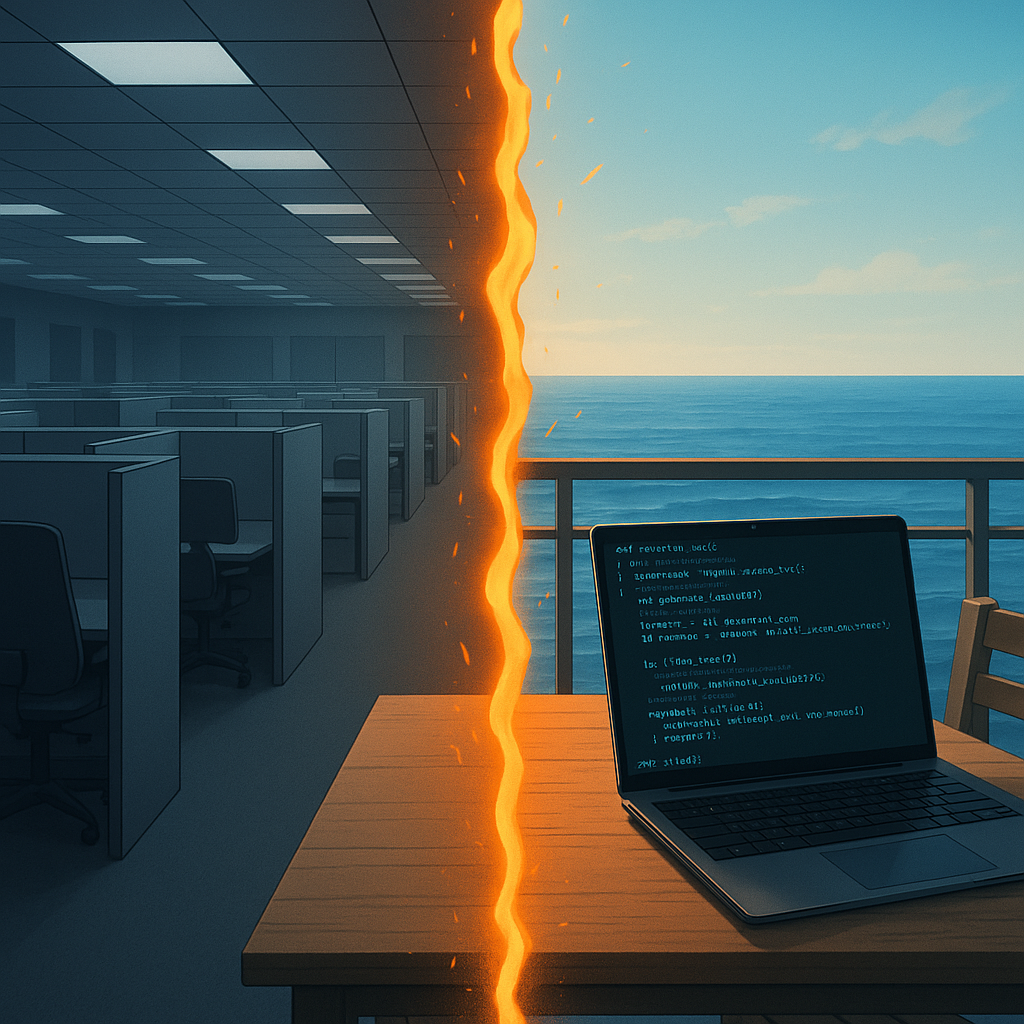
When companies rolled out their return-to-office mandates in 2023, they thought they were regaining control. Instead, they ignited something unexpected — a mass movement of individuals turning to AI to reclaim their freedom, time, and creative edge.
Between 2023 and 2025, more than 60 percent of large U.S. employers implemented hybrid or full RTO policies. Yet, surveys from FlexJobs and Gartner showed the same trend: people didn’t want to go back. Over 80 percent preferred remote or flexible setups, and nearly half said they’d quit before returning to a full-time office. Many did — but they didn’t disappear. They reinvented.
1. The Spark: Pressure → Innovation
Corporate leaders framed RTO as “restoring collaboration.” In reality, it triggered curiosity and resistance.
Amazon pushed five days. Google mandated three. Meta called for four “core” days. Dell made in-office work mandatory for entire divisions. The rhetoric was about synergy; the subtext was surveillance.
And that’s what sparked the shift.
Commuting again meant losing ten or more hours a week. Workers turned to AI tools — ChatGPT, Claude, Copilot, Notion AI — to take some of that time back. By mid-2024, ChatGPT had over 200 million active users. Copilot spread across millions of Microsoft 365 accounts. People started automating, delegating, and optimizing — not for their managers, but for themselves.
As one user on Reddit put it: “If I have to waste three days a week in traffic, I might as well build something that buys me those hours back.”
And they did.
(Related: The Great Return to Office Isn’t Killing Nomads — It’s Making Them Dangerous — placeholder link for upcoming Medium article.)
2. The Split: Corporate AI vs Personal AI
The RTO wave revealed a growing divide in how AI is used.
Corporate AI became a tool of oversight — meeting summaries, productivity dashboards, behavior metrics, compliance automation.
Personal AI became a tool of liberation.
(See related essay: How I Bend AI to Fit My Workflow as a One-Person Strategy Team)
People began building their own automation stacks: GPT assistants to manage email, scripts to track expenses, and AI copilots to handle design, writing, and client work.
By 2025, 38 percent of freelancers used AI every day — up from just 9 percent two years earlier. The largest gains came from individuals, not enterprises. The revolution shifted from corporate infrastructure to personal intelligence.
For a data overview, see Return-to-Office Mandates 2025 — YLS360.
3. The Fire: Individual Intelligence at Scale
AI didn’t just make work faster. It made independence scalable.
Creators used it to run media brands. Developers launched startups solo. Consultants automated their research pipelines. Designers turned prompts into portfolios.
A 2025 Upwork report found a 23 percent surge in freelancers who cited “AI leverage” as their biggest productivity gain. Entire industries now move through a new kind of decentralized intelligence — humans amplified by their digital counterparts.
RTO may have brought bodies back to buildings, but it also sent minds somewhere else entirely.
The cubicle returned. The worker didn’t.
4. The Fallout: Control Lost, Creativity Gained
For companies, RTO was about proximity. For individuals, AI became a form of sovereignty.
Those who stayed in corporate life used AI to quietly optimize and automate faster than leadership could track. Those who left built something entirely new — agile, independent, AI-augmented ventures.
The system recaptured attendance, but not allegiance.
Executives called it “efficiency.”
Entrepreneurs called it “freedom tech.”
5. The Future: The Great Reversal
By late 2025, decentralization isn’t a buzzword — it’s the default.
The office was supposed to centralize talent. AI decentralized it faster than any economic policy could.
The new hierarchy of work isn’t who controls the office space; it’s who controls the cognitive stack. The office has become optional. The assistant has become essential.
Humans and machines now collaborate in small, distributed ecosystems capable of competing with entire departments. That’s the new workforce model — local bodies, global intelligence.
The corporate mandate failed to suppress creativity. It accidentally set it free.
The Reckoning: Control Never Scales — Curiosity Does
Every age of control produces a generation of innovators. The printing press rose from censorship. The internet rose from centralized media. And now, the personal AI revolution rises from the cubicle’s return.
The more organizations tighten control, the more autonomy spreads.
And once independence compounds, you can’t unlearn it.
So maybe the real question isn’t whether RTO set the AI revolution on fire.
Maybe it’s whether you are ready to fan that flame.
Web SEO Metadata
Title: Did the Return-to-Office Set the AI Revolution on Fire?
Meta Description: How RTO mandates backfired — forcing workers to innovate, automate, and go independent. Discover how AI became the weapon of freedom for digital nomads and solo entrepreneurs.
Tags: AI Tools, Remote Work, Digital Nomads, Future of Work, RTO 2025, Work Independence
Read next: [The Nomad Data-Center — When Starlink Meets NVIDIA DGX Spark]
