

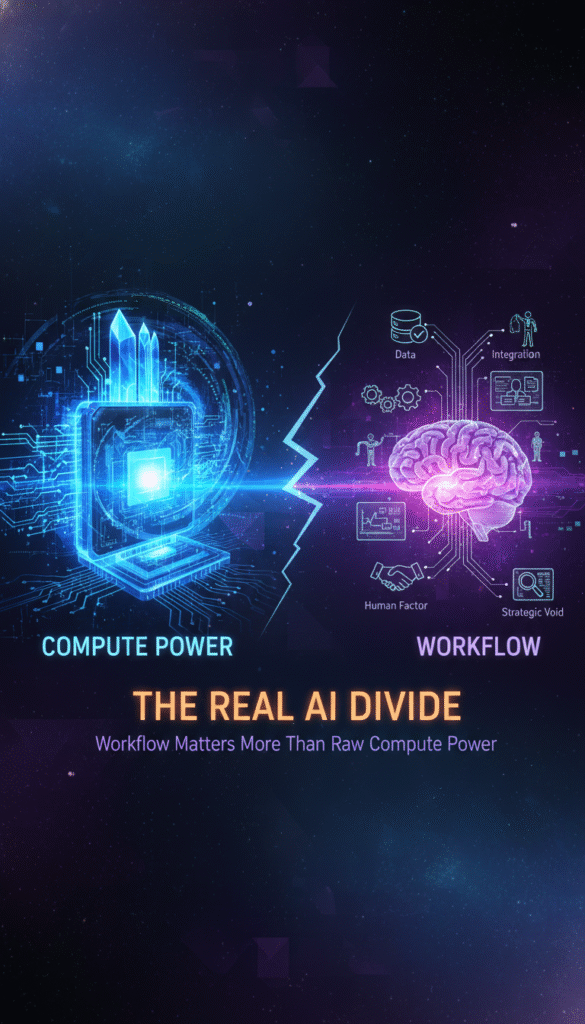
What will truly separate tomorrow’s business winners from the also-rans: owning the world’s most advanced data centers—or knowing how to rebuild work itself?
If you read the headlines, you’d think winning in AI requires $100 billion and a mountain of GPUs. The reality? Most small and medium-sized companies don’t need either.
The real AI gap today isn’t about data centers or custom silicon. It’s about how work is structured—and whether companies have the courage to rebuild their workflows around intelligence instead of inertia.
1. The $100B Mirage
Tech giants are spending at staggering scale. Microsoft, Amazon, and Alphabet together poured more than $100 billion into AI infrastructure last year. Wall Street buzzes, data centers glow, and the world watches the arms race.
But—how much does this spectacle affect the everyday business? Barely registers.
Most small and mid-size firms don’t need to train models or compete on compute. What they need is to improve the way their people and systems talk to each other.
“A $1,000 model that saves 2 hours a day beats a $1 million system no one uses.”
The obsession with “AI investment” tricks many into thinking transformation comes from hardware. In truth, the leverage lies in software and process—often at a fraction of Big Tech’s spend.
2. The Hidden Cost of Chasing Giants
Many SMEs fall into the imitation trap.
- They buy tools, not transformations.
- They deploy chatbots without rethinking customer flow.
- They install “AI CRMs” but never redesign core sales rhythms.
Real-world cautionary tale: A mid-sized logistics firm spent $60K on an AI routing dashboard. It sat unused for 9 months—because dispatchers still relied on WhatsApp threads and Excel. The tool never touched the actual decision loop.
Real value isn’t in having AI—it’s in embedding intelligence where work actually happens.
The question isn’t “What AI do we have?” but “Where does AI make decisions simpler, faster, or smarter?”
3. The Real Edge: Software Intelligence
AI power is compute. AI leverage is integration.
Smaller firms win by connecting existing software through intelligent, self-improving workflows—not by building from scratch. You don’t need a PhD or a data-science team—you need orchestration.
Live examples:
- A local retailer used Zapier to connect Shopify orders to live Slack inventory alerts—freeing 3 staff hours daily for in-store service.
- A 12-person consulting firm adopted Notion AI to auto-generate project recaps from client calls—cutting admin from 4 hours to 12 minutes per engagement.
Tools like Make.com, Notion AI, Zapier, or frameworks like LangChain let you link everyday systems—email, CRM, spreadsheets, support tickets—into adaptive feedback cycles.
This is where the Workflow ROI Flywheel kicks in:
text
Data → Smarter decisions → More data → Tighter models → Faster nudgesEach loop compounds productivity without new infrastructure. Big Tech buys the engine. You’re building the racetrack.
4. Reconstruct, Don’t Reinvent
Forget “AI transformation.” Think workflow reconstruction.
Step 1: Map decision nodes
- Bottlenecks: Where do delays cluster?
- Gridlock: Which approvals stall momentum?
- Repeatable: What rules never change?
Step 2: Apply AI at the nodes
- Summarize inbound noise (emails, tickets, forms).
- Prioritize by pattern or probability.
- Route work automatically to the right person or channel.
Keep humans in the loop. AI should assist, not amputate, the decision-making chain.
5. Quick Start Checklist: 90-Day Implementation
Ready to move from idea to action? Here’s a roadmap to workflow-based AI momentum—no new hires, no heavy spend.
- Identify 3 workflows where time or accuracy consistently drops (e.g., customer onboarding, internal reporting, content production).
- Pick one repetitive edge task to automate with a lightweight AI tool: data entry, scheduling, summarization.
- Link the tool to your existing stack (email, CRM, analytics) for flow, not just task completion.
- Add manual review early, tweak rules, then delegate more as trust builds.
- Track hours saved, response speed, or error reduction weekly—small wins stack fast.
- Hold a 15-minute Friday “AI stand-up”: What worked? What didn’t? What’s next?
Data point: Companies that actively orchestrate software integration see average process time drop by 20% within a year (Deloitte, 2024).
6. The Future Belongs to Adaptive Systems
Big companies have capital. Smaller ones have agility.
They can change faster, integrate quicker, and correct course without bureaucracy.
The next decade’s winners won’t be those with the largest models—they’ll be those that make intelligence part of their workflow DNA. Those who rebuild work around AI—rather than building AI around work—will gain compound leverage that Big Tech’s spend can’t buy.
Call to Action
Open your calendar. Block 15 minutes right now to diagram your most painful process.
Ask:
Where could software guide, nudge, or automate this flow?
📖 Prefer reading on Medium?
This article is also available (with highlights and reader comments) on Medium:
