

How Weight-Loss Drugs Changed Health, Culture, and Policy
In 2025, the breakthrough wasn’t weight loss. It was what weight loss started changing downstream.
This isn’t a diet article. It’s a systems article about what happens when appetite becomes adjustable at scale—how health gets redefined, how markets adapt, how policy scrambles, and how the person in the middle gets blamed for forces upstream.
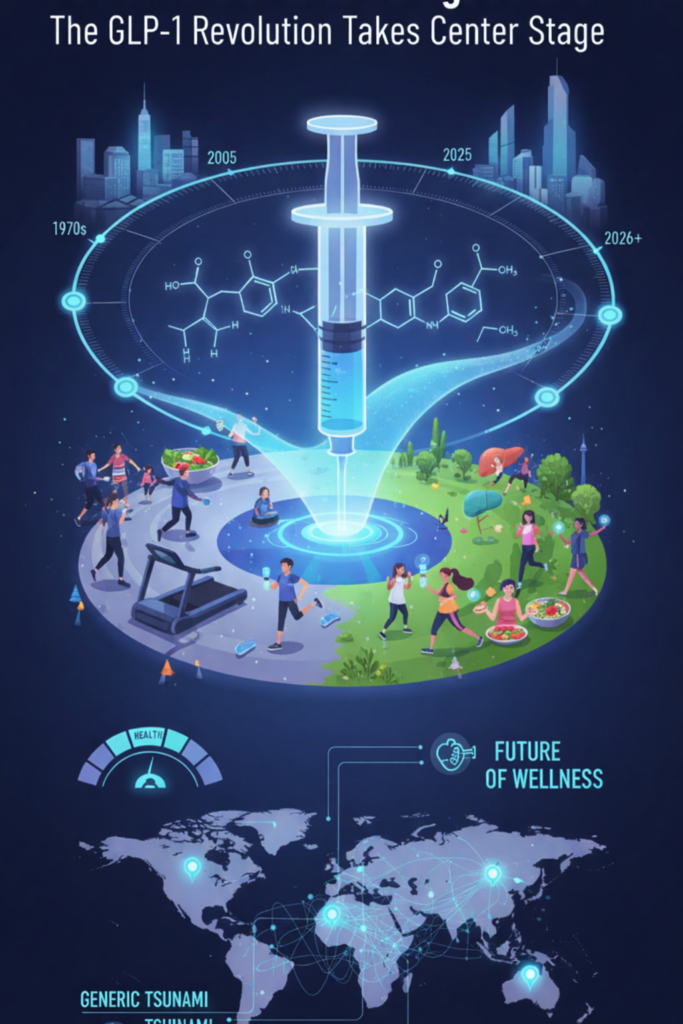
For years, obesity sat in an awkward place in public discourse: medical enough to be feared, moralized enough to be blamed. “Lifestyle change” became the universal script—sometimes helpful, often weaponized. Meanwhile, the modern food environment kept getting better at doing what it’s designed to do: drive consumption.
Then, by late 2025, the conversation changed texture.
Not because GLP-1–based weight-loss drugs were new. They weren’t. Mainstreaming started earlier.
But by late 2025, the downstream effects became impossible to ignore.
Not because people were losing weight. Because appetite itself—the engine behind consumption, habit, shame, and risk—started looking adjustable at scale.
That’s when everything else followed: policy fights, market adaptations, cultural whiplash, and a new argument about what “health” even means.
Why Late 2025 Became Impossible to Ignore
GLP-1 mainstreaming didn’t begin in 2025. The adoption curve started earlier.
The claim here is narrower—and stronger:
By late 2025, the downstream effects became impossible to ignore.
That’s what makes it a pivot moment in systems terms. When a tool stops being “a product people try” and becomes “a force institutions react to,” you’re no longer watching a trend. You’re watching a reconfiguration.
Three markers made that visible:
- Employers started reacting like this was a cost-and-coverage problem, not a personal choice.
When benefits teams and HR economics start treating appetite drugs as a budget and access issue, the story has moved from private behavior to institutional policy. - Convenience and scale moved closer to the mainstream.
The moment pill-format options enter the conversation as a real-world access accelerant—not just a concept—adoption stops depending on injection tolerance. That shifts the ceiling. - Retailers began adapting to smaller appetites as a customer segment.
When product lines and merchandising start accommodating GLP-1-style eating patterns, the market is admitting something simple: consumption behavior is changing at scale.
Late 2025 didn’t invent the drug era. It made the second-order effects undeniable—and once employers, regulators, and retailers react, the narrative has already changed.
What These Drugs Actually Changed
Let’s name the core mechanism without myth.
These medications reduce appetite and increase satiety. People feel full sooner. Cravings quiet. Portions shrink without constant internal negotiation.
For many users, that’s the first time weight loss stops feeling like a daily war.
System reality: the modern food economy is built on keeping appetite activated; the new weight-loss drug era is built on turning that signal down.
This is why the category hit culture like a wave. The modern food environment is engineered to keep appetite engaged—cheap calories, hyper-palatable combinations, constant cues, frictionless access.
When appetite becomes medically modifiable, it disrupts a foundational assumption of the system: that desire will keep returning on schedule.
Most of the public debate misses this point. The real shift isn’t “a drug helps people eat less.” It’s that the default relationship between people and food can change.
And once that default changes, the moral narrative starts cracking.
The Category Behind the Moment
The engine of late 2025 was the rise of GLP-1–based weight-loss drugs and newer variants that build on the same appetite-regulating biology.
They moved from diabetes care into mainstream weight management, and then into culture.
That matters, because it reframed obesity—quietly but decisively—from “a failure of will” into “a condition with tools.”
But tools always come with tradeoffs. And the public conversation has been uneven: hype on one side, backlash on the other.
The truth is less dramatic and more important:
These drugs can be transformative. They are not a complete definition of health.
What Broke in 2025
The old narrative said: weight is mainly willpower.
Late 2025 didn’t disprove personal agency—it exposed that agency was being asked to fight an engineered environment without tools. Once tools became mainstream, the moral story couldn’t hold.
This is the shift most people are reacting to without naming it:
- The old world demanded discipline to survive the environment.
- The new world introduced a lever that changes the environment’s impact.
That’s why the debate keeps overheating. People aren’t just arguing about a medication. They’re arguing about the story they’ve used to explain bodies for decades.
Before 2025, IF Already Shifted the Ground
Intermittent fasting changed the weight-loss conversation before the drugs did. Not as a miracle, but as a reframing: timing matters, hunger isn’t always an emergency, and structure can change appetite without moralizing it.
IF didn’t solve the food environment. But it gave people a lever that felt behavioral instead of moral. It proved something simple but important:
When you change the pattern of eating, you often change the experience of eating.
Late 2025 didn’t replace that shift—it escalated it, moving appetite control from behavioral structure into medical intervention.
A New Standard of Weight Loss — And a New Risk of Confusion
Weight loss can correlate with health improvements. For many people, it lowers metabolic risk, improves mobility, and can reduce strain on joints and organs. That’s real.
But late 2025 also introduced a new kind of confusion:
Weight loss is not automatically health.
A person can lose weight while also:
- losing muscle,
- under-eating protein,
- avoiding strength work,
- feeling physically weaker,
- and living on low-nutrition “small meals” that look controlled but aren’t supportive.
The old trap was: discipline fixes everything.
The new trap is: weight loss fixes everything.
Neither is true.
The more honest framing is this:
Medication can change appetite. Structure determines whether the outcome becomes health—or just smallerness.
Reality Check: What These Drugs Don’t Replace
☐ Protein + strength work (to protect function while weight drops)
☐ Nutrition quality (small meals can still be nutritionally weak)
☐ Sleep + stress regulation (appetite and adherence live here too)
☐ Clinical oversight (dose management, side effects, risk screening)
☐ The upstream environment (marketing, pricing, convenience, defaults)
The drug changes appetite. It doesn’t redesign the world that shaped appetite in the first place.
Side Effects: The Non-Negotiable Reality
This isn’t a moral story. It’s a biological one.
Many people experience side effects, especially early or during dose increases:
- nausea,
- constipation or diarrhea,
- stomach discomfort,
- fatigue or a “flattened” feeling.
Most of that is manageable. But it’s still a tradeoff. And it shapes adherence.
There are also less obvious challenges that matter in real life:
Lean mass loss and weakness
When appetite drops sharply, people often eat less protein and do less resistance training—not because they don’t care, but because energy and routine shift. Over time, that can mean muscle loss and physical weakness.
If you’re shrinking a body, you want to shrink fat—not function.
Nutrition drift
Smaller portions can become lower nutrition if people default to “whatever goes down easily.” Appetite suppression changes intake, but it doesn’t automatically improve food quality.
The maintenance question
For many users, the experience raises a hard reality: maintaining results may require continued use. If medication stops, appetite can return—and with it the old environment-driven pull.
That doesn’t mean the drug failed. It means the system is still the system.
This is where “lifestyle” needs to be reframed.
Not as blame. As support.
“Lifestyle Change” Without Moralizing It
You’re right to resist the judgment embedded in the phrase.
Obesity is not a character flaw. People living with obesity are not lazy. And the idea that the solution is simply “try harder” collapses under even basic scrutiny of the environment:
- ingredient engineering,
- label gymnastics,
- aggressive marketing,
- portion inflation,
- ultra-processed convenience,
- stress and sleep disruption,
- time scarcity,
- and a built environment that doesn’t reward movement.
Individuals still have agency—but it’s agency under constraint.
A better way to say it is:
Behavior matters. But behavior happens inside a system designed to shape default behavior.
Late 2025 didn’t remove responsibility. It exposed how dishonest it was to place responsibility only on the individual.
What Actually Determines Outcomes
The drug changes appetite. Outcomes depend on the support layer.
In practice, results hinge on three levers:
- Protein + strength (to protect function while weight drops)
- Routine design (to prevent nutrition drift and relapse-by-default)
- Clinical oversight (to manage side effects and long-term use)
Without that layer, the system produces a predictable outcome: smaller bodies, mixed health, and louder backlash.
Culture Clash: Health Goals vs Thinness Ideals
Once appetite suppression becomes mainstream, the cultural question changes.
It’s no longer just: “Is it healthy to lose weight?”
It becomes: “What happens when thinness can be medicalized?”
Because culture doesn’t treat weight neutrally. It treats weight as identity, virtue, attractiveness, discipline, and status.
So these drugs get used for different reasons:
- risk reduction,
- mobility and quality of life,
- metabolic health,
- and yes—appearance.
Those motivations can coexist in the same person. Which is why the public discourse keeps overheating.
The cultural danger isn’t weight loss.
The danger is collapsing “health” into a look—and then using “science” as moral cover for aesthetic obsession.
In late 2025, thinness didn’t just become desirable. It became justifiable.
That’s a powerful—and risky—shift.
There’s also a quieter shift happening underneath the public debate. Many users describe the benefit as turning down “food noise”—the constant background pull of cravings and decision fatigue. But that quiet can come with tradeoffs. Eating isn’t only fuel; it’s social, cultural, and emotional. When appetite changes fast, the relationship to pleasure and ritual can change with it too.
When science shrinks bodies, what follows?
Policy follows. Markets follow. Narratives follow.
And the person in the middle gets framed as the problem—when they’re often the victims caught in the system.
They pay once at the checkout—and again at the pharmacy.
The Incentives Loop Nobody Wants to Say Out Loud
This is the part of the story most people avoid.
There’s an uncomfortable symmetry here.
The modern food environment is engineered to maximize consumption—cheap calories, hyper-palatable formulation, frictionless access. Then a second industry arrives with engineered appetite suppression and long-term recurring revenue.
It doesn’t require a conspiracy to become a machine. It only requires aligned incentives.
One side expands demand. The other monetizes the correction.
That’s the loop. Not cartoon villains. Not “evil people.” A feedback system where prevention is weak, consumption is engineered, and treatment becomes the business model for managing the downstream consequences.
A system that profits from both the cause and the cure will rarely prioritize prevention.
Access, Coverage, and the Reality of Inequality
Once something works, the next question is: who gets it?
That’s where late 2025 turned political.
If these drugs remain expensive and unevenly covered, they become another tool that benefits the already-advantaged—while everyone else is told to rely on willpower inside the same engineered environment.
That’s a recipe for resentment.
It also creates predictable consequences:
- people seeking shortcuts,
- dubious online sellers,
- inconsistent medical oversight,
- and a widening gap between those who can access structured care and those who can’t.
This isn’t a “personal responsibility” story. It’s a resource allocation story.
And whenever demand outruns safe access, unregulated markets appear. That’s not moral failure. That’s systems behavior.
A Global Pressure Test: Why India Matters Here
This is not only a U.S. story.
Countries facing rapid rises in obesity and diabetes are forced into faster decisions about:
- how risk is defined,
- what prevention looks like,
- and whether medication becomes part of national health strategy or a private market luxury.
India is an especially sharp case because metabolic risk can show up at lower body weights than many Western standards assume, and because scale forces hard choices quickly.
As affordability shifts over the next few years—especially as competition expands and newer versions arrive—the bigger question becomes:
Can clinical supervision, nutrition support, and long-term monitoring scale with access?
Because appetite-modifying medication without support is a recipe for uneven outcomes: success for some, problems for others, and confusion for everyone.
What Follows Next
If late 2025 was the normalization moment, the next phase is about second-order consequences.
Here’s what to watch:
1) The definition of health fight intensifies
More people will lose weight without necessarily becoming stronger or healthier. That will force a recalibration of what outcomes we value: weight, function, metabolic markers, fitness, strength, stability.
2) Industries adapt
Food companies, retailers, restaurants, wellness brands, and insurers will all adapt—because appetite shifts change the economics of consumption.
3) Policy and ethics become unavoidable
Coverage, equity, regulation, and safety oversight will matter as much as efficacy. The story will move from “does it work?” to “how should society use it responsibly?”
And underneath all of it is the same principle:
When science shrinks bodies, the downstream effects aren’t optional. They’re inevitable.
Closing Loop
So—did 2025 redefine weight loss?
Yes, because it moved weight loss from a moral story to a systems story: appetite became modifiable, and everything downstream began to reorganize—coverage, markets, stigma, and responsibility.
The real question now isn’t whether the drugs work. It’s whether society can use them without turning weight loss into a proxy for health—and without blaming the people caught in the loop.
Here’s the closing question worth sitting with:
If appetite can be medically altered, what happens to stigma, access, and responsibility?
And before you scroll, answer the headline for yourself:
Did 2025 redefine weight loss?
If you want more writing that treats modern trends as systems (not memes), follow me here on Medium.
If this helped you see the GLP-1 era more clearly, give it a clap so it reaches readers who need nuance more than noise.
Meta description (SEO)
Did 2025 redefine weight loss? A systems-level look at GLP-1 drugs, intermittent fasting, access, side effects, and the incentives loop shaping health, culture, and policy.
Points to take away
- Late 2025 wasn’t the start of GLP-1s—it was when the downstream effects became impossible to ignore (employers, markets, and policy started reacting).
- The real shift is appetite becoming adjustable at scale, which changes consumption patterns and the moral story around obesity.
- GLP-1s can be transformative, but weight loss isn’t automatically health—muscle loss, weakness, and nutrition drift are real risks.
- Intermittent fasting mattered first because it reframed weight loss as structure, not moral struggle; GLP-1s escalated that shift from behavior to intervention.
- What the drugs don’t replace: protein + strength training, nutrition quality, sleep and stress regulation, clinical oversight, and an improved food environment.
- Culture is now split between health and thinness ideals, and “food noise” relief can also change pleasure, ritual, and social eating.
- Access and affordability shape outcomes, and uneven coverage predictably creates shadow markets and unsafe substitutes.
- The incentives loop is uncomfortable but real: people pay once at the checkout and again at the pharmacy—often as victims caught in the system.
