

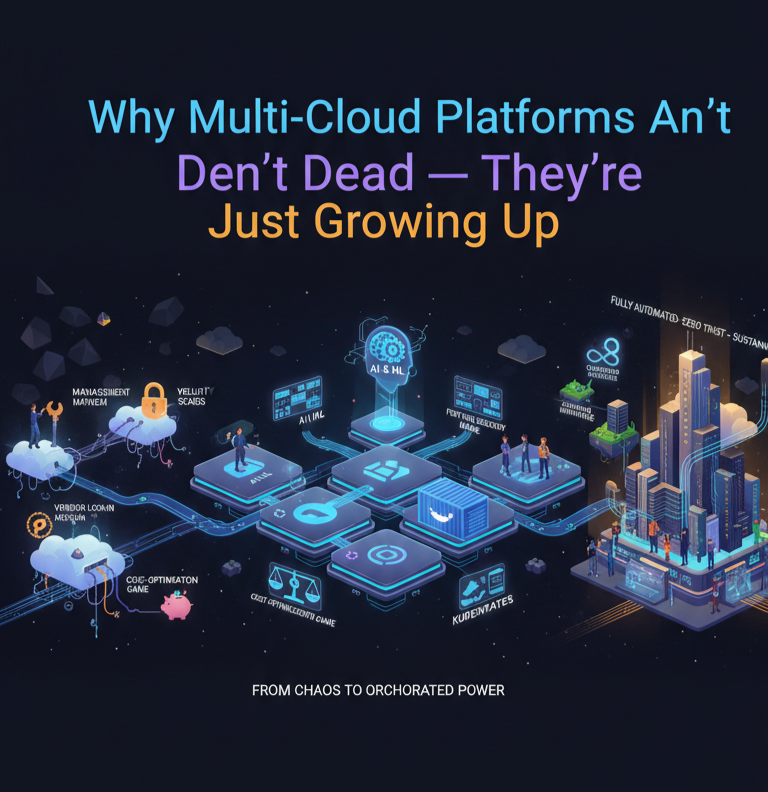
Remember when multi-cloud was the buzzword, touted as the next evolutionary leap in IT infrastructure? Then came the operational headaches, the unexpected costs, and the whispers of “maybe this isn’t all it’s cracked up to be.” Well, hold that thought. The rumors of multi-cloud’s demise have been greatly exaggerated, perhaps even wishful thinking on the part of those who prefer simpler, single-vendor solutions.
Multi-Cloud Platforms (MCPs) aren’t just surviving; they’re evolving. They’re maturing past the awkward teenage phase of fragmented tools and unpredictable bills, and becoming an indispensable backbone for modern businesses. Let’s explore their journey from hyped infancy to essential IT strategy, examining the nuances and the not-so-obvious implications.
I. The Basics: What Exactly is a “Grown-Up” Multi-Cloud Platform?
Forget the simple notion of merely using two clouds. A “grown-up” multi-cloud platform represents a deeply strategic approach. It’s about artfully blending services from two or more cloud providers – be they public, private, or a hybrid mix – to deliberately leverage their distinct features, pricing models, and specialized capabilities. It’s less about spreading risk for the sake of it, and more about engineering the perfect environment for each workload.
Why play the field, you ask? The core idea hinges on avoiding vendor lock-in, a perfectly understandable desire in a world dominated by a few cloud behemoths. Beyond that, it’s about maximizing flexibility – the ability to pivot, to adapt, to choose the right tool for the right job. And, crucially, it’s about building a more resilient and cost-effective IT environment, one that isn’t beholden to the whims of a single provider.
What, then, are the superpowers that define a truly effective MCP?
- Smart Workload Juggling: The capacity to intelligently place applications on the best-fit cloud. Think Kubernetes for ultimate portability, allowing you to shift workloads seamlessly based on performance, cost, or even geopolitical considerations.
- One Dashboard to Rule Them All (Ideally!): Centralized management tools that offer a single pane of glass for oversight and control across diverse environments. This isn’t just about monitoring; it’s about orchestrating, automating, and understanding the complex interplay between different cloud resources.
- Fort Knox Security: Enhanced security services that work consistently across your entire cloud ecosystem. We’re talking Network Detection and Response (NDR), Endpoint Detection and Response (EDR), and the implementation of Zero Trust architectures to ensure that every user and device is continuously validated.
- Disaster-Proofing Your Business: Spreading workloads across multiple clouds means if one region goes down, or even an entire provider experiences an outage, your critical applications remain up and running. It’s the ultimate insurance policy against single points of failure.
- The Cost-Optimization Game: Savvy MCP deployments allow you to pick and choose the most economical services from different providers, playing them off against each other to drive down costs. This requires sophisticated cost monitoring and management tools, but the potential savings can be substantial.
II. From Humble Beginnings: The Multi-Cloud Origin Story
To truly understand the present state of multi-cloud, we must trace its evolution. The journey has been anything but linear.
- The Dawn of Cloud (2000s – Early 2010s): AWS, Azure, and GCP burst onto the scene, ushering in the era of the “single cloud.” Businesses, often tentatively, began migrating workloads to the cloud, usually choosing one primary provider. SaaS solutions also gained traction, offering specialized functionality without the burden of infrastructure management.
- The Hybrid Stepping Stone (Early 2010s): Companies started cautiously blending on-premises infrastructure with public clouds, giving rise to the hybrid cloud model. This was often driven by regulatory requirements, data residency concerns, or simply a desire to retain control over sensitive workloads. Hybrid cloud served as a valuable learning experience, exposing organizations to the complexities of managing distributed environments.
- The Multi-Cloud Awakening (Mid-2010s Onwards): Organizations began to realize that no single cloud provider did everything perfectly. The desire for specialized services – machine learning from Google, perhaps, or high-performance computing from AWS – coupled with the allure of better bargaining power and vendor independence, propelled multi-cloud into the spotlight.
- Awkward Teenage Years (Early Challenges): This initial enthusiasm was quickly tempered by a series of practical challenges.
- Management Mayhem: Juggling different tools, interfaces, and APIs from various cloud providers proved to be a major headache. Automation was limited, and manual intervention was often required, leading to inefficiencies and errors.
- Security Scares: Ensuring consistent security and compliance across different provider policies was a nightmare. Different clouds had different security models, different logging mechanisms, and different compliance certifications, making it difficult to maintain a unified security posture.
- Data Dilemmas: Moving data between clouds was often costly and complex, leading to latency issues and potential data breaches. The sheer volume of data being generated and processed made data migration a daunting task.
- The Talent Gap: There simply weren’t enough IT professionals who knew how to manage such complex, multi-vendor setups. The demand for cloud architects, security engineers, and DevOps specialists far outstripped the supply.
- The Irony of Lock-in: Ironically, while trying to avoid vendor lock-in, interoperability issues sometimes created a new kind of “distributed lock-in.” Companies found themselves dependent on proprietary services and APIs across multiple clouds, making future migrations just as difficult and expensive as before.
III. The Current Buzz: Why Multi-Cloud is Booming (and Still Causing Headaches)
Today, multi-cloud is no longer a niche strategy; it’s rapidly becoming the de facto standard. A significant majority of enterprises – estimates range from 89% to 92% – now employ a multi-cloud approach in some form or another. The market for multi-cloud management platforms is projected to skyrocket, indicating the growing importance of effective orchestration and governance.
But what is driving this seemingly unstoppable adoption?
- True Vendor Freedom: Less reliance on any single provider translates into greater flexibility and enhanced negotiation power. Companies can play providers off against each other, driving down costs and securing better terms.
- Bulletproof Resilience: Higher availability and improved disaster recovery capabilities are key drivers. By distributing workloads across multiple clouds, organizations can minimize the impact of outages and ensure business continuity.
- Best-in-Class Everything: Tapping into unique, specialized services offered by different providers allows companies to build truly cutting-edge solutions. Google’s AI capabilities, AWS’s extensive compute resources, and Azure’s enterprise integration services can be combined to create a synergistic ecosystem.
- Strategic Cost Advantage: Optimizing spending by leveraging diverse pricing models – spot instances, reserved instances, serverless computing – can lead to significant cost savings. However, this requires careful planning and continuous monitoring.
Despite these compelling advantages, the path to multi-cloud nirvana remains fraught with challenges.
- “Is It Worth The Trouble?” Debate: Some critics argue that multi-cloud often introduces more complexity and cost than it solves, leading to “overestimated benefits and underestimated effort.” They contend that the operational overhead of managing disparate environments outweighs the potential gains.
- The “Distributed Lock-in” Trap: As mentioned earlier, avoiding one vendor only to become dependent on proprietary services across several is a real risk. This “distributed lock-in” can make future migrations just as painful and costly as traditional vendor lock-in.
- Complexity Overload (Still!): Managing disparate interfaces, billing systems, and technical standards from different providers remains a top challenge. It’s akin to juggling multiple remote controls that don’t communicate with each other.
- The Expanded Attack Surface: More clouds inevitably mean more entry points for potential threats. Maintaining a consistent security posture across a heterogeneous environment requires a monumental effort.
- “Billing Chaos”: Unforeseen costs, hefty data transfer fees, and inconsistent billing models can quickly lead to budget overruns. Without robust cost management tools and processes, multi-cloud can become a financial black hole.
- The Ongoing Talent Crunch: Skilled professionals fluent in multiple cloud ecosystems remain a scarce and highly sought-after commodity. The lack of qualified personnel can significantly impede multi-cloud adoption and effectiveness.
- Integration Nightmares: Getting different clouds to play nicely together often involves a frustrating, custom-coding marathon. The lack of standardized APIs and integration tools makes it difficult to build seamless workflows across cloud boundaries.
IV. Looking Ahead: MCPs in the Age of AI and Beyond
The future of multi-cloud is inextricably linked to emerging technologies like artificial intelligence, edge computing, and quantum computing. These technologies will not only shape the capabilities of MCPs but also drive new use cases and business models.
- AI Takes the Driver’s Seat: AI and Machine Learning will be increasingly central to future MCPs, enabling:
- Intelligent workload distribution and predictive capacity planning. AI algorithms will analyze historical data and real-time metrics to dynamically allocate workloads to the most appropriate cloud resources.
- Autonomous security operations and AI-powered threat detection. AI will automate security tasks, such as vulnerability scanning, intrusion detection, and incident response, freeing up security teams to focus on more strategic initiatives.
- Real-time, granular cost optimization (hello, FinOps!). AI will continuously monitor cloud spending and identify opportunities to reduce costs, such as automatically scaling down resources during periods of low demand.
- Edge Computing Integration: Expect deeper integration with edge devices, bringing data processing closer to the source for IoT and real-time analytics. Multi-cloud platforms will orchestrate resources across both centralized cloud environments and distributed edge locations.
- Fortified Security Frameworks: Unified security posture management, advanced encryption, and widespread adoption of Zero Trust architectures will become standard. Automated compliance will be key, ensuring that organizations adhere to relevant regulations and industry standards.
- The “Everything-as-Code” Revolution: Infrastructure-as-Code (IaC), Policy-as-Code (PaC), and FinOps-as-Code will drive ultimate automation and consistency. This approach will enable organizations to define and manage their cloud infrastructure, security policies, and cost controls using code, making it easier to scale and adapt to changing requirements.
- Containers & Serverless as Foundation: Kubernetes and serverless computing will continue to underpin portable, scalable, event-driven applications across clouds. These technologies will provide a common platform for deploying and managing applications, regardless of the underlying cloud infrastructure.
- Green Cloud Initiatives: Growing demand for sustainable cloud options with reduced carbon footprints and renewable energy sources will drive providers to offer more environmentally friendly services. Organizations will increasingly factor sustainability into their cloud selection criteria.
- The Quantum Cloud Horizon: While still largely futuristic, quantum computing is being explored for optimizing highly complex multi-cloud workloads. Quantum algorithms could potentially solve optimization problems that are intractable for classical computers, leading to significant performance improvements.
- The Rise of True Unified Management: More sophisticated multi-cloud management platforms (CMPs) will emerge, offering single-pane-of-glass visibility and automation to truly simplify complex environments. These platforms will provide comprehensive tools for managing infrastructure, security, cost, and compliance across multiple clouds.
Conclusion: Multi-Cloud Platforms – Fully Matured, Fully Essential
In conclusion, multi-cloud isn’t just surviving; it has matured into a sophisticated, strategic necessity. It represents a paradigm shift in how organizations approach IT infrastructure, moving away from monolithic, vendor-centric models towards a more flexible, agile, and resilient approach. It’s about intelligently harnessing the diverse strengths of different cloud providers to drive innovation, ensure business continuity, and optimize operational efficiency.
While challenges undeniably remain – complexity, security concerns, cost management – the future of multi-cloud is undeniably bright, increasingly intelligent, and progressively automated. For businesses looking to thrive in a dynamic digital landscape, embracing the evolution of multi-cloud isn’t just an option—it’s an imperative. The question is no longer whether to adopt multi-cloud, but how to do it effectively.
