

What if the West never meant “never again” as a principle — only as a boundary around itself?
Gaza reveals that the promise of “never again” was always conditional - and Palestinians remain outside its protection.
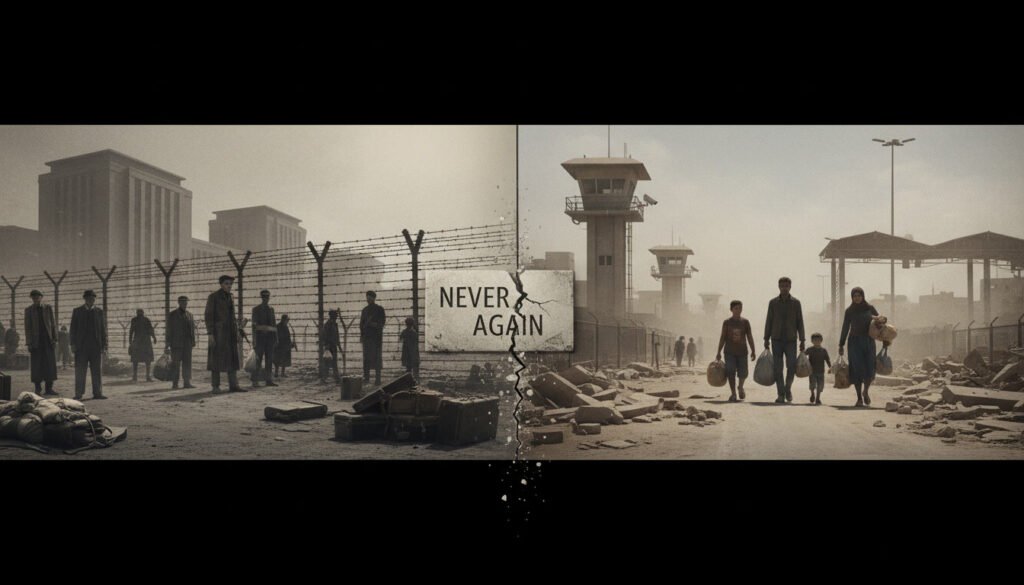
The phrase became the moral foundation of the post-1945 order.
But look at the historical record, and a darker truth appears:
“Never again” was never a universal vow.
It was a jurisdiction.
And Palestinians have always lived outside it.
This isn’t the same crime repeated.
It’s the same institutional paralysis — re-applied, re-targeted, and re-justified.
I. The First Pattern: Europe Saw the Threat — and Looked Away
History → Mechanism → Consequence
In the 1930s and early 1940s, European governments:
- documented persecution
- debated refugee quotas
- tightened borders
- produced conferences, not protection
They knew the machinery forming around Jewish communities.
They expressed concern rather than action.
They allowed catastrophe to mature.
The lesson should have been global.
Instead, the West coded an asterisk into its memory:
- Never again — inside Europe.
- Never again — for this group.
- Never again — when convenient.
Not: Never again, as a principle of humanity.
II. 1948: The Moment the Script Reappeared
The Nakba wasn’t an anomaly — it was a resumption.
The same powers that failed Jewish refugees now shaped Palestinian fate.
Britain:
Disarmed Palestinian communities while allowing Zionist militias to consolidate force.
Then walked away.
United States:
Recognized the new Israeli state instantly.
Recognized Palestinians only as a humanitarian category —
a label that acknowledges suffering while denying rights.
Europe:
Still drowning in guilt.
Still unable to confront its own complicity.
Still willing to treat Palestinian dispossession as an “unfortunate necessity” for Jewish safety.
The machinery of inaction didn’t disappear.
It just recalibrated.
III. Empire Handed Off to Superpower
From the British Mandate to the American Doctrine
Britain built the initial structure:
- empower external actors
- contain indigenous resistance
- “manage” the conflict instead of representing the population
America expanded it:
- Cold War containment
- UN veto protection
- bipartisan military funding
- diplomatic frameworks that indefinitely delay Palestinian claims
The rest of the West followed the same gravitational pull:
- critique without consequence
- concern without pressure
- symmetry rhetoric that erases power imbalance
And Germany lives inside its own paralysis:
Guilt became policy.
Policy became reflex.
Reflex became an alibi that makes Palestinian suffering unmentionable —
because acknowledging it would force a confrontation with historical trauma weaponized as diplomatic doctrine.
IV. New Vocabulary. Same Mechanism.
(Arendt’s warning: bureaucracy is where morality goes to hide.)
Then:
“We are monitoring the situation.”
Now:
“We are deeply concerned.”
Then: displacement labeled “migration.”
Now: ethnic cleansing reframed as “disputed territory.”
Then: selective legality.
Now: international law used as a menu — invoked when useful, ignored when inconvenient.
Nothing structural changed.
Only the language got smoother.
V. Understanding Is Not Excusing
Societies fear examining their failures because it feels like indictment.
But explanation is not endorsement.
Mechanism is not justification.
Understanding is not approval.
Avoiding analysis doesn’t prevent repetition.
It guarantees it.
VI. What “Never Again” Actually Became
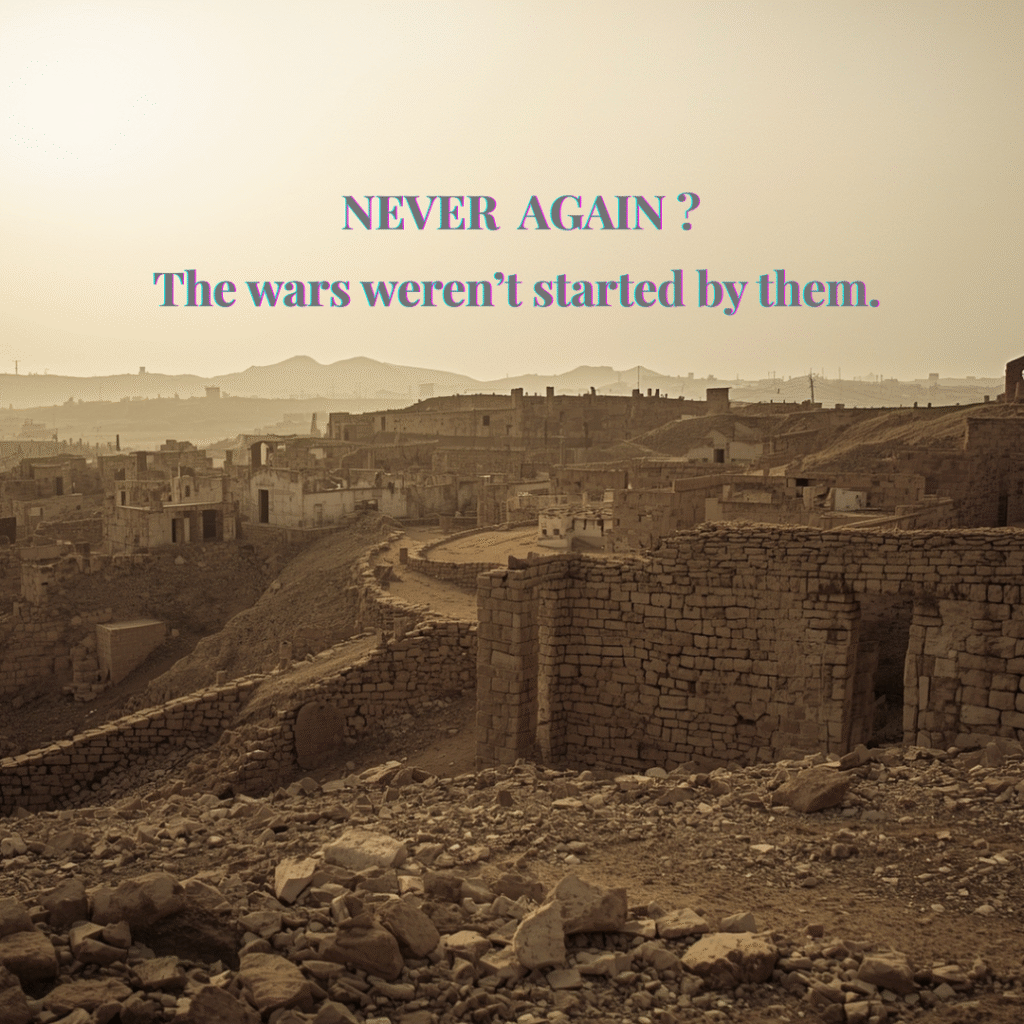
A moral slogan with geographic borders.
Acceptable:
Use Holocaust memory to justify intervention in the Balkans.
Unacceptable:
Use it to critique settlement expansion.
Permissible:
Invoke genocide in Rwanda.
Forbidden:
Invoke it in Gaza.
A principle turned into diplomatic branding—
powerful when aligned with Western interests,
prohibited when it complicates them.
VII. Gaza: The Pattern, Fully Matured
Over two million people trapped under conditions that anywhere else would trigger unanimous international action:
- blockade
- repeated bombardment cycles
- external governance proposals without Palestinian agency
- humanitarian framing without political rights
The Western script:
- acknowledge suffering
- call it “complex”
- equate occupier and occupied
- prioritize alliances
- issue statements
- impose no consequences
Underneath:
Palestinian life remains negotiable in Western strategic calculus.
VIII. Sympathy Is Cheap. Solidarity Costs.
Sympathy:
- press releases
- emergency aid
- expressions of concern
Solidarity:
- condition military aid
- recognize Palestinian statehood
- apply Ukraine standards to Gaza
- treat settlements as the war crimes they are
- dismantle the diplomatic shield that enables permanent occupation
Sympathy is performance.
Solidarity carries political risk.
That’s why governments choose the former.
IX. The Paralysis Has a Name
This isn’t confusion.
This isn’t complexity.
This isn’t “both sides.”
This is policy by choice:
- the choice made in the 1930s to restrict refugee entry
- the choice made in the 1940s to let proof accumulate while waiting
- the choice made in 1948 to treat displacement as inevitable
Different victims.
Different rhetoric.
Same structural failure.
International law wasn’t too weak to stop this.
It was built with escape hatches big enough to drive policy through.
X. The Pattern’s Final Reveal
Atrocity rarely needs enthusiasm.
It needs neutrality.
Genocide doesn’t start with mobs.
It starts with:
- bureaucratic euphemisms
- administrative delays
- legal exceptions
- international deferrals
Governments that wait become participants.
XI. The Question That Decides 2025
In 1945, the world pledged: never again.
But Gaza forces the unavoidable question:
Never again for whom?
- Only when politically convenient?
- Only within Europe?
- Only when allies aren’t implicated?
If any of those are true,
then “never again” was never a principle —
only a slogan.
Palestinians aren’t asking the West to repeat history’s worst crimes.
They’re asking the West to stop repeating its complicity.
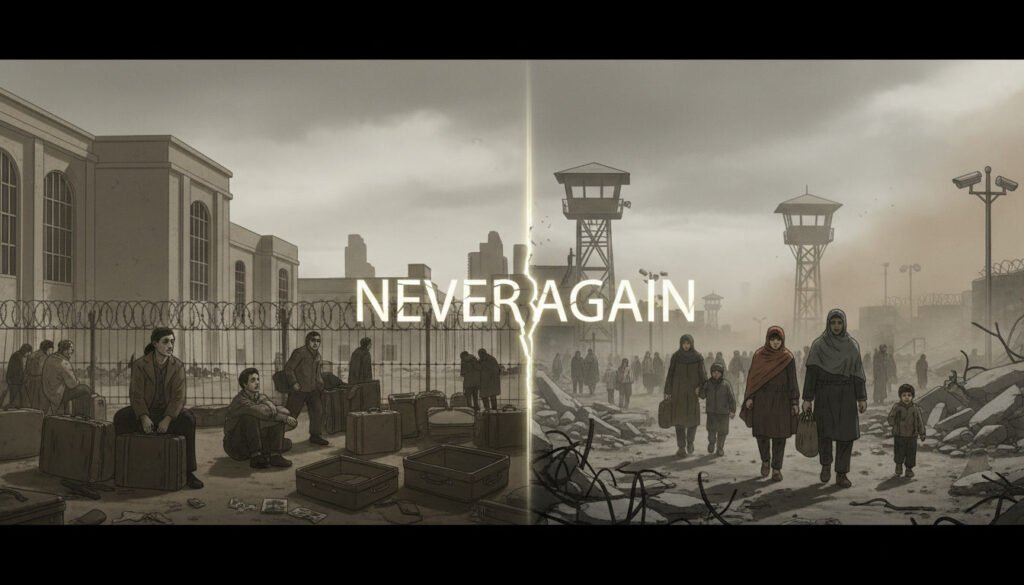
TL;DR (Voice Search Optimized)
The West’s promise of “never again” was never universal — it was conditional.
From Europe’s refugee failures in the 1930s to the Nakba in 1948 to Gaza today, Western governments have repeated the same pattern: selective outrage, rhetorical sympathy, and moral principles applied only when convenient. Gaza isn’t an exception — it’s the latest expression of a long-standing structure where Palestinian rights are negotiable and Western alliances override uni
SEO Keywords
Gaza, Nakba, Western foreign policy, Holocaust memory, international law, institutional complicity, historical patterns, Hannah Arendt analysis
AI/Voice Search Meta Description
A diagnostic analysis of how the West applied “never again” selectively — confronting genocide in Europe while enabling or excusing Palestinian displacement. Explains the continuity from the 1930s refugee failures to the Nakba to Gaza today, showing the persistent pattern of sympathy without action and morality overridden by political interests.
If you like to read it on Medium, here is the Link
https://medium.com/systemic-reckonings/when-never-again-was-never-universal-081cf2c28da5
