

The economic incentives have evaporated — but the front-line risk hasn’t.
I. The Formula That Kept Europe in Line for 75 Years
Every European prime minister since 1945 has operated under one unspoken contract:
Carrot: the U.S. consumer market (22% of global GDP), venture capital ($140 bn annually into EU startups in 2023), and Big Tech platforms extracting €100 bn a year in ad revenue from Europe.
Stick: 100 U.S. B61 nuclear bombs stored across five NATO states, NSA SIGINT no European agency can match, and the U.S. Air Force’s 620-aircraft C-17 fleet — a capability Europe couldn’t replicate in six decades.
Dependency itself is leverage.
The logic was baked in from the beginning: Europe must stay close, aligned, and dependent.
II. Trump Is Sawing the Carrot in Half
Washington is pivoting toward a Pacific showdown with Beijing.
Europe is still locked into a Cold War posture on the eastern flank — for a war it didn’t start and might not survive.
Tariffs and Policy Shifts
- 25% on cars → $18 bn German export loss (DIW Berlin)
- 10–20% on steel/aluminum → €7 bn annual impact on EU producers
- “Buy American” infrastructure rules → €300 bn in contracts closed to European firms
- Digital-services retaliation → €15 bn tax threat to Apple/Google margins
This is not negotiation.
It is the repricing of the relationship in real time.
Result: the economic incentive collapses while military exposure stays constant.
When the carrot shrinks by 30% and the stick remains full-length, the alliance gets re-priced — whether anyone admits it or not.
III. The Front-Line Risk Nobody Names
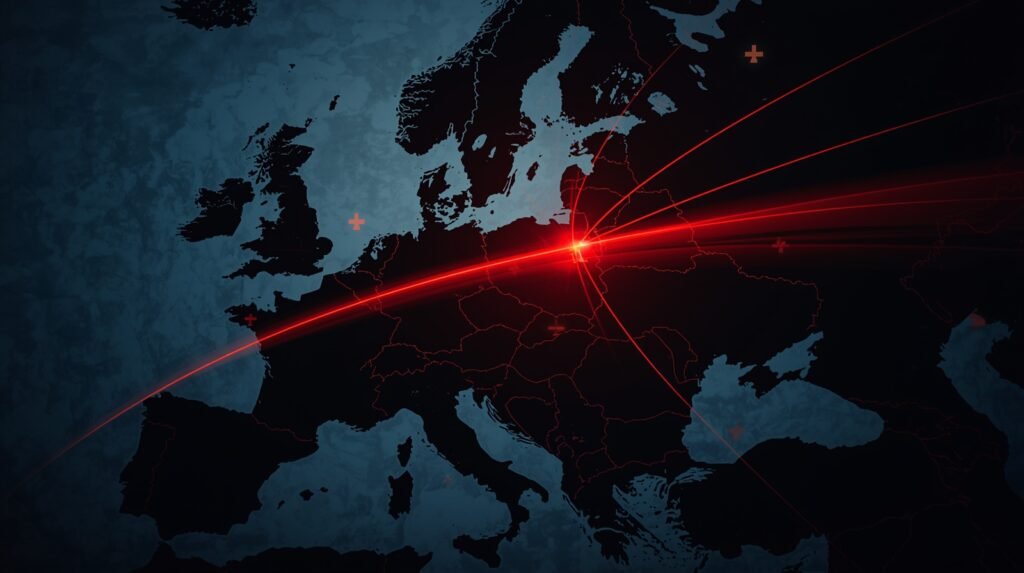
Europe is the battlefield. The United States is the rear area.
- First nuclear weapons used: 100 U.S. B61s in Belgium, Germany, Italy, Netherlands, Turkey.
- First cities to burn: Warsaw (300 km from Kaliningrad), Tallinn (100 km from Russia).
- First economies to seize: eurozone GDP −8% to −12% in week one of war (ECB 2023 simulation).
In Warsaw, air-raid sirens test monthly.
In Washington, most people couldn’t find Kaliningrad on a map.
Decision loop: Washington → Brussels → front line.
Everyone decides — except the people who would absorb the first strike.
No European leader will ever say:
“We are risking World War III to keep access to the U.S. market.”
But that is the quiet trade embedded in every NATO communiqué since 2014.
IV. Deterrence Only Works When Everyone Stays Predictable
Western strategy rests on one assumption: both sides are rational enough to pull back from the abyss.
That assumption cracks when:
- A U.S. president muses about “nuclear explosions” on American soil (Trump, Oct 2024).
- A loyalty-first cabinet removes dissent — zero senior officials with nuclear-strategy experience (2025 roster).
- NATO keeps moving eastward — Finland’s 1,300-km border, HIMARS in Poland, Aegis Ashore in Redzikowo.
Unpredictability has become a political brand.
Russia’s 2020 doctrine authorizes first use if the state’s existence is threatened.
Europe lives inside Moscow’s warning distance.
Washington doesn’t.
The room for miscalculation is now measured in single-digit kilometers.
V. Why the Truth Stays Buried
Media frame tariffs as “trade spats” and NATO expansion as “burden-sharing.”
European politicians use coded language:
- “strategic autonomy” (Macron)
- “European pillar” (von der Leyen)
U.S. strategists preach “transatlantic cohesion” in public —
and admit in private briefings that a fragmented Europe serves American interests.
The only people who say it plainly — Mearsheimer, Walt, Kissinger — are written off as “realists” outside the acceptable window.
VI. Europe’s Own Addiction to Indecision
The cage isn’t only American-made.
Europe’s internal weaknesses are structural:
| Obstacle | Impact |
|---|---|
| 27 national vetoes | No unified foreign policy |
| 17 defense prime contractors | 6× unit cost vs. U.S. |
| 2.3-year average electoral cycles | No long-term strategy possible |
Europe isn’t just dominated — it is complicit in its own fragmentation.
VII. The Breaking Point Is Already Visible
Three triggers will force the silence to end:
- Economic pain: German car exports −30%, French farmers blockading ports over U.S. soy quotas.
- A near-miss escalation: A Russian missile lands in Poland; Article 5 is triggered for 48 hours; markets lose €2 trillion — then stand down.
- A leader with nothing to lose: A lame-duck chancellor or second-term French president finally says: “We refuse to be the battlefield for a country that taxes our cars.”
VIII. The Reckoning
European voters will not subsidize a security guarantee that arrives with economic punishment.
American taxpayers will not bankroll NATO while pivoting toward Asia.
The Global South is watching:
If Europe cannot escape the orbit of a declining hegemon, no one can.
Europe may not be choosing dependency.
But it is choosing not to choose.
History doesn’t forgive those who sleepwalk into war behind a partner already facing another direction.
The post-1945 order is collapsing in slow motion.
Someone has to name the trade-offs before the next crisis names them with fire.
Europe’s options are binary:
Remain a rich, fragmented appendage — economically squeezed, militarily exposed, strategically irrelevant.
Or build a real fourth pole — a €100 bn defense fund, nuclear-sharing, and the political will to say no when the risk falls on European soil.
That era is over.
The question now is whether Europe acts — or keeps pretending it has no choice.
Europe faces rising nuclear risk as U.S. economic incentives shrink and NATO’s front-line exposure grows. This analysis examines the silent trade-off driving today’s transatlantic strategy.
Keyword Cluster (Semantic SEO)
Primary: Europe nuclear risk, NATO escalation, U.S.–EU relations
Secondary: tariffs Europe, transatlantic bargain collapse, frontline risk Europe
Intent:
- “Is Europe too dependent on the U.S.?”
- “Why is Europe at front-line nuclear risk?”
- “What is the real cost of NATO expansion?”
