

Corruption isn’t always the product of a master plan.
More often, it begins as a quiet exception—a shortcut taken under pressure, rationalized in the moment.While media narratives often focus on conspiracies, villains, or grand embezzlement schemes, this oversimplifies a far more systemic issue.
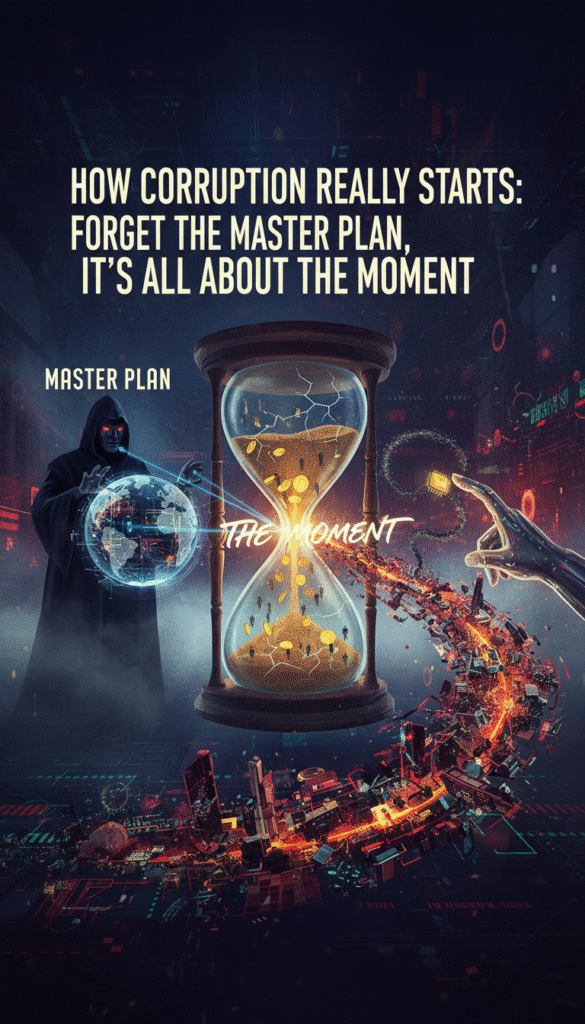
This piece was inspired by recent global headlines, where corruption is often exposed as scandal—but rarely understood in its subtle beginnings.
We tend to focus on the masterminds.
But the truth is more unnerving: most corruption doesn’t start with a plan.
It starts with a pause. A breach. A shortcut that “feels necessary.”
That’s the moment that matters.
And if we want to prevent collapse, that’s where we need to look first.
1. The Real Origins: Stress, Systems, and Small Breaches
🧠 Why It Starts Quietly
Corruption is frequently a side effect of:
- Overwhelming pressure: Emergency procurement, political urgency, or economic volatility.
- Weak oversight: When systems are under strain, verification processes weaken.
- Moral gray zones: Individuals are forced to “just make it work,” often without full awareness of ethical boundaries.
📌 Example:
A procurement officer fast-tracks a vendor without the third required bid — because the deadline is in 12 hours. The intent isn’t theft — it’s speed.
But this is the first breach — a hinge point where integrity bends under operational weight.
2. Psychological Triggers That Justify Corruption
Key Cognitive Biases:
- Present Bias: Favoring immediate benefits over future consequences.
- Self-Serving Bias: Rationalizing unethical behavior as deserved or harmless.
- Slippery Slope Effect: Small unethical decisions make larger ones feel more acceptable over time.
Psychological Mechanisms:
- Moral Disengagement: Internal narratives like “Everyone does this” or “It’s for the greater good.”
- Unconscious Drift: Decisions made automatically under pressure, without full ethical reflection.
🧩 Corruption often isn’t a conscious plan. It’s a cascade of justified actions made under time stress, peer pressure, or institutional fog.
3. Historical Roots: Corruption as a Civilizational Pattern
- Mesopotamia: The Code of Hammurabi outlawed bribery almost 4,000 years ago.
- Plato and Aristotle: Saw corruption as a fundamental risk to justice and the republic.
- Enlightenment Thinkers: From Machiavelli to Rousseau, corruption was framed as a disease of the state, not just the individual.
Evolution of Understanding:
From moral failing → to individual flaw → to systemic design failure.
4. Why “Good People” Succumb: Systems + Incentives
Structural Catalysts:
- Low pay, high discretion: Officials with power but limited compensation face ongoing temptation.
- Impunity: When no one is punished, the behavior spreads.
- Inequality: Systems favor the connected, creating resentment and moral fatigue.
Personal Risk Factors:
- Desperation: Financial stress, family obligations, job insecurity.
- Overconfidence: Belief that one won’t get caught or that their behavior is unique.
- Social Proof: Observing peers take shortcuts without consequence normalizes the act.
5. The Moment vs. the Master Plan: A False Binary?
Research Insight:
- Slippery Slope Theory: Small compromises create new norms.
- Sudden Opportunity Model: One big, tempting chance can trigger a fall.
- Blended Reality: Most real-world corruption cases are a mix — a moment leads to a pattern which forms a plan.
6. Modern Prevention Strategies: From Theory to Action
🔐 Systemic Design Fixes
- Audits + Rotations: Reduce long-term power concentration.
- Dual-approval systems: Add friction to prevent impulsive decisions.
- Digital government: Move approvals and services online to reduce informal access points.
🧠 Behavioral Interventions
- Scenario-based ethics training
- “Nudge” techniques that promote pausing and reflection
- Leadership modeling: Ethics must cascade from the top
💡 Tech Tools
- AI fraud detection
- Blockchain traceability
- Open data portals for citizen oversight
🚨 Technology is a tool — it can prevent corruption or deepen it. Design determines the outcome.
7. Final Insight: Don’t Just Hunt Scandals — Interrupt the Moment
Corruption doesn’t begin with a villain — it begins with a vulnerable system, a pressured person, and a moment that slips by.
Every act feels small when it happens.
The collapse comes not from a single breach, but from the accumulation of tolerated exceptions.
