

The Hidden Workflow Crisis No One Saw Coming
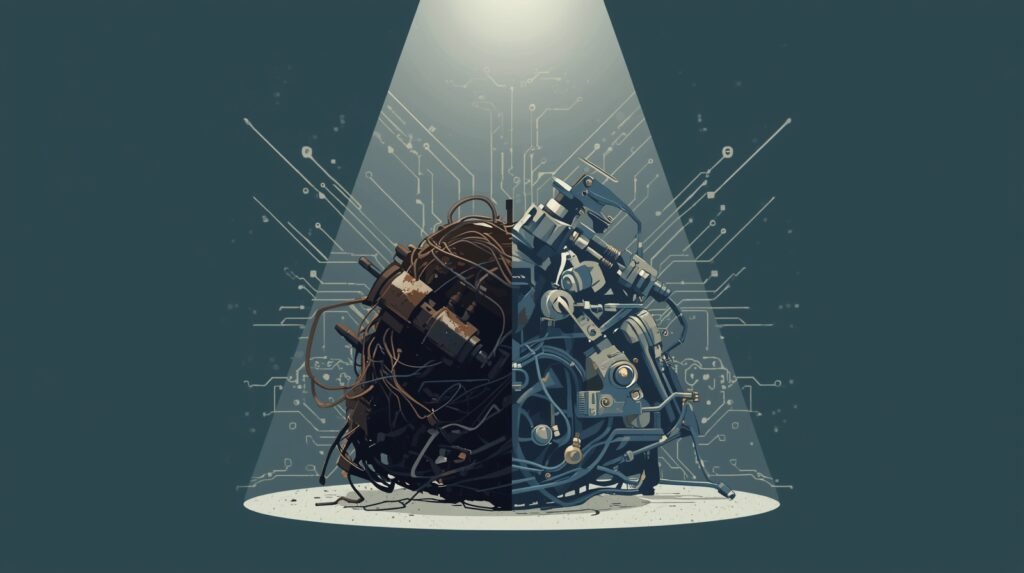
AI Didn’t Show Us a New Future — It Showed Us the One We Forgot to Build
For years, teams lived with slow approvals, scattered data, and steps no one remembered creating. Everything “worked,” as long as no one inspected it too closely.
Then AI arrived — not because it broke anything, but because it forced a comparison.
Leaders suddenly watched slick demos where tasks flowed effortlessly. They saw perfect automations, clean handoffs, and systems that seemed to run themselves. For the first time, they had a clear view of what their workflow should look like — and how far from that picture they really were.
Many had the same quiet thought:
“Why don’t we work like that?”
That question unlocked the hype — and the hype led directly to a mistake.
Companies rushed in assuming the model would absorb their internal chaos and magically return order. They treated AI like a shortcut instead of a structural reset — believing new tech would somehow repair old logic.
It never does.
AI didn’t show companies a new future. It showed them the future they forgot to build.
The Trap: Patching AI onto Broken Processes
You cannot automate your way out of a workflow that wasn’t built for automation.
But that’s exactly what most companies tried to do. Instead of rethinking the structure, they:
- patched AI onto old processes
- forced models to adapt to outdated rules
- added exceptions to exceptions
- created logic chains nobody documents
- built systems only one person knows how to maintain
This isn’t modernization. It’s accelerating dysfunction.
Here’s what this looks like in practice: A client built a system where ChatGPT generated customer responses, fed them to a Zapier chain that updated an Excel file, which triggered a Slack notification, which someone manually copy-pasted into Salesforce. Six tools. Three platforms. One fragile chain that broke every time ChatGPT updated its output format.
This is how duct-tape systems are born.
And AI is the worst thing you can attach to them.
Whatever the workflow is, AI will multiply it.
If the workflow is messy, AI will multiply the mess.
If the workflow is clean, AI will multiply the clarity.
Why This Becomes a Long-Term Trap
When you twist AI around a legacy workflow, you don’t just create a short-term failure — you create a long-term trap.
Because you end up with:
- vendor lock-in
- fragile automations that break with one small change
- shadow logic nobody admits exists
- data paths nobody controls
- updates that collapse the system
- dependencies on a model you can’t replace
- technical debt disguised as innovation
This is the organizational version of building a skyscraper on cracked concrete — and assuming the elevator system will keep it standing.
AI doesn’t hide structural problems. AI multiplies them.
The Real Problem: AI Exposes Process Failure, Not Tech Failure
Once you tear open the workflow, the truth becomes obvious: AI never exposes a technology problem first. It exposes a process problem.
The model isn’t the bottleneck. The workflow is.
The moment you see how your organization really operates — the undocumented steps, the broken paths, the manual fixes nobody admits to — you understand why AI feels inconsistent or unreliable.
It’s not the model. It’s the environment you’re dropping it into.
And that’s the shift leadership has to make:
AI isn’t here to save your workflow. AI is here to stress-test it.
If the workflow is clean, AI will elevate it.
If the workflow is chaotic, AI will crush it.
Every company eventually faces this point of truth.
How to Rebuild a Workflow Without Creating Another Monster
When companies finally admit their workflow is outdated, they often try to fix it the same way they broke it: by adding more layers.
A tool here. A patch there. A “temporary” shortcut that becomes permanent. A plug-in to glue two old systems together.
Piece by piece, they create something no one can fully explain — a workflow stitched together from good intentions and bad timing.
That’s why rebuilding starts at the bones.
Step 1: Map How Work Really Happens
Every company has two workflows: the official version and the real one.
Forget the charts. Follow the people. Observe the handoffs, detours, and unspoken rules. The bottlenecks live in the shadow version.
Spend a week shadowing your team. You’ll find:
- approval steps that exist because someone retired in 2015 but nobody questioned the process
- data being manually transferred between systems that should talk to each other
- three people doing the same quality check because nobody trusts the other two
This isn’t hypothetical. This is what the real workflow looks like in most organizations.
Step 2: Remove the Layers That Only Exist Out of Habit
Workflows collect debris over time — old approvals, outdated checks, and fear-based redundancies.
Ask “Why?” until a step survives or collapses.
Most steps collapse.
For example: A finance team required three signatures on purchase orders under $500. Why? “Because we always have.” Dig deeper: it was implemented in 2008 after one fraudulent purchase. The person who committed the fraud left in 2009. The policy stayed for 15 years, slowing every single small purchase and costing more in delayed productivity than it ever saved.
Cut it.
The resistance you’ll face here isn’t technical — it’s political. People defend broken workflows because their authority is tied to being the approval gatekeeper or the person who “knows how the system works.” Expect pushback. Expect people to claim the sky will fall. Document everything, run a pilot, and let the results speak.
This is where most workflow rebuilds fail: not from technical challenges, but from organizational inertia.
Step 3: Rebuild Using Modern Logic, Not Legacy Logic
A healthy workflow is simple, predictable, and modular.
Linear where it can be.
Branched only when necessary.
Documented so it survives turnover.
Tool-agnostic so it doesn’t die when the vendor changes.
That last point is critical: your workflow should never depend on a specific AI model.
If your workflow breaks every time GPT-5 changes its output format, you don’t have a workflow — you have a dependency. Build in abstraction layers. Use standard data formats. Design for replaceability.
This isn’t “AI readiness.” This is what modern work should look like — with or without AI.
Step 4: Add AI Only Where It Gives You Leverage, Not Decoration
AI is not the solution for chaos. AI is the amplifier.
If the structure is sound, AI can scale it.
If the structure is weak, AI will collapse it faster.
This is the difference between growth and disaster.
AI should only sit where it:
- removes friction (automating data entry, not decision-making)
- improves consistency (standardizing outputs, not replacing judgment)
- handles work humans shouldn’t be doing (processing thousands of documents, not strategy)
Not decoration. Not hype. Not because someone online made it look magical.
What Success Looks Like
How do you know when your workflow is AI-ready?
You know you’re ready when:
- a new team member can understand the process by reading documentation, not by shadowing someone for three months
- you can swap one tool for another without rebuilding the entire system
- failures are visible immediately, not three steps downstream
- you can explain every step’s purpose in one sentence
- removing AI from the workflow doesn’t break it — it just makes it slower
If your workflow only works because of AI, you’ve built on sand.
The Implementation Reality
Let’s address the question leadership is asking: “How long does this take?”
For a small team (10-20 people): 6-8 weeks to map, redesign, and implement a core workflow.
For a department (50-100 people): 3-4 months.
For an entire organization: 6-12 months, done in phases.
This feels slow when you’re watching competitors deploy AI tools in weeks. But here’s what nobody tells you: those quick deployments are creating technical debt that will take years to untangle. You’re not falling behind — you’re building a foundation that will actually hold weight.
The ROI shows up in unexpected places:
- onboarding time cut by 60% because workflows are documented
- vendor costs drop because you’re not locked into proprietary systems
- AI updates don’t break your operations
- you can actually measure what’s working
This is infrastructure work. It’s not flashy. But infrastructure is what separates companies that scale from companies that collapse.
The Wake-Up Call
Most companies didn’t realize how outdated their workflows were until AI held a mirror to them. They believed the model would fix everything. But AI didn’t expose a tech problem — it exposed a design problem.
If the workflow is weak, AI will break it faster.
If the workflow is strong, AI will scale it further.
The winners of this era won’t be the ones chasing bigger models. They’ll be the ones who rebuilt their workflow from the ground up — and then plugged intelligence into a structure that could finally hold it.
AI is optional. A modern workflow is not.
Fix the workflow first. Then let AI adapt to you — not the other way around.
